returntotheocean.com

return to the ocean

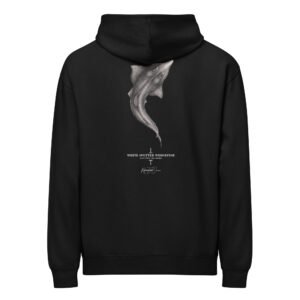
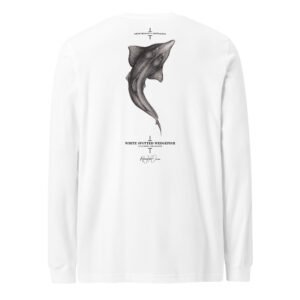
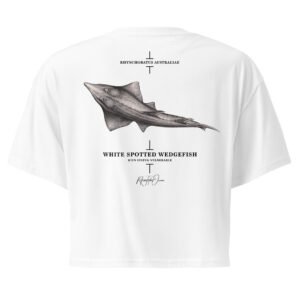
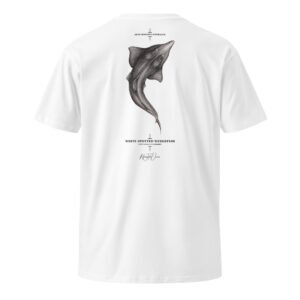
white spotted wedgefish

One of the ocean's rarest silhouettes — half shark, half ray, and running out of time.

shop the collection

the white spotted wedgefish

Rhynchobatus australiae

meet the animal

about the white spotted wedgefish

Named for their oddly angular, shark-like head, wedgefish are one of the ocean’s strangest hybrids — built like a shark, but genetically a ray. As bottom-dwelling predators, they hunt crustaceans, molluscs, and small fish along soft seafloor and reef edges, helping keep those communities in check the way any mid-level predator does for its ecosystem.

Despite their size and shark-like build, wedgefish are slow, harmless bottom feeders with no fight in them at all — which has made them tragically easy to catch. Of the eleven known wedgefish species, ten are now Critically Endangered, hunted for fins considered among the most valuable in the shark-fin trade, with global numbers down by more than 80% over the last 45 years.

sofie seyah

meet the artist

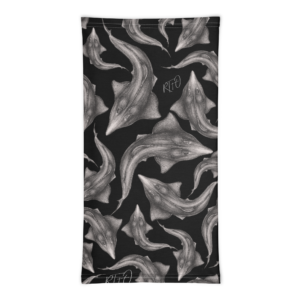
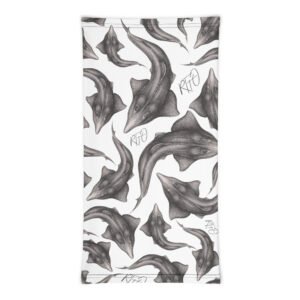
Based in Western Australia, Sofie Seyah brings this Wedgefish to life in watercolour — building the design through soft washes of color rather than hard outlines, giving the piece a fluid, almost underwater quality that suits an animal so rarely seen. The piece came entirely from Sofie’s own imagination, with no reference used at all. It’s that combination of a medium built for movement and an eye trained on Western Australia’s own waters that gives this piece its sense of life, for an animal most people will never get the chance to see themselves.

MIYARU PROJECT

the cause we're supporting

About MIYARU

This design supports the Miyaru Project, a Maldivian NGO based in Fuvahmulah dedicated to shark and ray research and conservation. Fittingly, the wedgefish itself carries this exact duality in its own name — in Dhivehi, the local language, it’s called Madimiyaru, literally “ray-shark.” Miyaru’s researchers work alongside local communities and international scientists to study the Maldives’ shark and ray populations, and in 2026 opened the country’s first Shark Research and Conservation Hub in Fuvahmulah — a dedicated space for research, education, and citizen science, born from a UNESCO Biosphere Reserve that’s home to some of the highest elasmobranch (shark and ray) biodiversity on Earth, much of it still barely studied.

EXPLORE MORE

YOU MIGHT ALSO LIKE

Shopping Basket
Scroll to Top