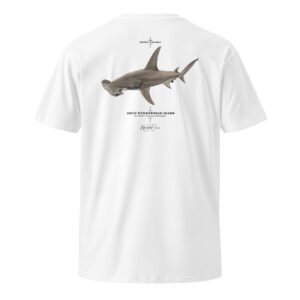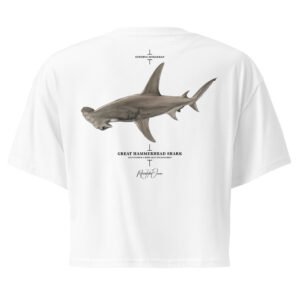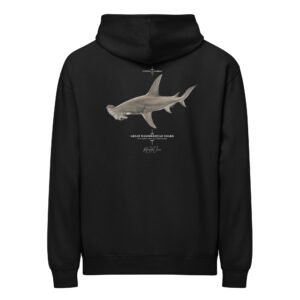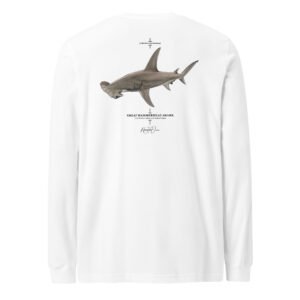

Few silhouettes in the ocean are as instantly recognisable as a hammerhead. The great hammerhead is the biggest of them all, a tall-finned, wide-headed hunter that patrols reefs, coastlines and open ocean in warm waters around the world. It is also one of the most threatened sharks on the planet.
Here is the science behind the great hammerhead, the story of the artist who drew our design, and the conservation work your purchase helps support.
Meet the great hammerhead (Sphyrna mokarran)
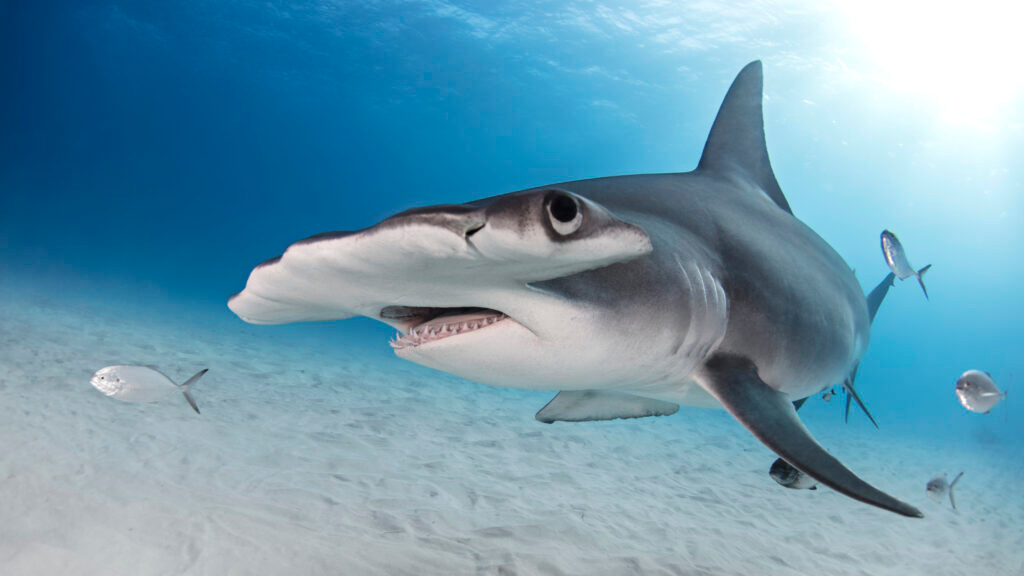
The great hammerhead is the largest of the nine or so hammerhead species. Most adults are around three and a half to four metres long, and the biggest individuals can reach close to six metres. You can pick a great hammerhead from its relatives by its huge, sickle-shaped first dorsal fin and the almost straight front edge of its head, with a small notch in the middle.
They are found in tropical and warm temperate waters worldwide, including northern Australia, the Maldives, the Bahamas and the Red Sea. They tend to be solitary and are known to travel long distances, with tagged individuals covering well over a thousand kilometres.
Why the hammer? The science of the cephalofoil
That flattened, wing-shaped head has a proper scientific name: the cephalofoil. Scientists have spent decades working out what it is for, and the answer seems to be “a bit of everything”.
- A wider field of view. With the eyes set at either end of the hammer, hammerheads get a wider field of view and better depth perception in front of them than sharks with narrow heads.
- A bigger sensor array. Sharks detect the tiny electrical fields given off by living animals using pores called the ampullae of Lorenzini. Spreading those pores across a wide head works like a metal detector sweeping the sand, helping hammerheads find prey buried in the seafloor.
- A hunting tool. Great hammerheads love stingrays. They have been seen using their heads to pin rays to the seabed before biting, and individuals have been found with dozens of stingray barbs lodged in their mouths and jaws.
- Agility. The cephalofoil may help with lift and sharp turns, letting hammerheads manoeuvre quickly when chasing prey.
Great hammerheads also have an unusual swimming trick. Research using tags and cameras has shown they often swim rolled onto their side, at angles of up to 75 degrees. By doing this, their giant dorsal fin acts like a wing, reducing drag and saving energy, which may help explain why that fin is so tall.
A young family in shark terms
Sharks have been around for more than 400 million years, but hammerheads are relative newcomers. Genetic studies suggest the hammerhead family, the Sphyrnidae, split from their requiem shark relatives (the group that includes bull, reef and tiger sharks) somewhere in the last 20 to 50 million years.
Interestingly, the winghead shark, which has the most extreme head of all (up to half its body length), sits near the base of the hammerhead family tree. That suggests early hammerheads may have started with very wide heads, and the shape has been shrinking and growing in different directions ever since.
Slow to grow, quick to lose
Great hammerheads give birth to live young, nourished in the womb through a placenta-like connection, much like mammals. A female has a litter of anywhere from around six to over forty pups, but usually only every second year, and they take years to reach maturity.
That slow life history makes them very vulnerable to fishing. Great hammerheads are also notoriously stressed by capture. Many die on the line or in the net, even if they are released afterwards. Their large fins are highly valued in the shark fin trade, and they are caught both deliberately and as bycatch around the world.
As a result, the great hammerhead is now listed as Critically Endangered on the IUCN Red List, with steep declines recorded across much of its range.
The artist: Sofie Seyah
Our Great Hammerhead design was created by Sofie Seyah, who is based in Gathaagudu (Shark Bay), Western Australia. Sofie is a marine scientist turned artist, and her watercolour and ink illustrations combine scientific precision with creative expression. She captures the anatomy, movement and character of marine species with remarkable attention to detail.
Sofie’s deep connection to Shark Bay and its marine life is at the heart of her work. After years in marine science, she turned to art as a way to share her fascination with the ocean and inspire a greater appreciation for the animals in it. Her Great Hammerhead balances scientific accuracy with artistic expression, turning one of the ocean’s most recognisable predators into wearable art with a conservation purpose. Sofie also illustrated our White Spotted Wedgefish design.
40% of the profits from this design go directly to Sofie.
The cause: Project Hiu
Every Great Hammerhead purchase supports Project Hiu. Based in Indonesia, one of the world’s biggest shark-fishing nations, Project Hiu partners with shark fishing communities to offer alternative livelihoods that protect sharks rather than exploit them.
Instead of heading out to catch sharks, fishers are supported to take people out on eco-tourism trips, earning an income from sharks that stay alive in the ocean. Through education and community-led conservation, Project Hiu helps reduce shark fishing, builds ocean awareness and empowers local people to become conservation leaders.
It is conservation that recognises a simple truth: protecting sharks works best when it also works for the people who live alongside them.
Shop the Great Hammerhead collection
Wear the great hammerhead and help protect it. 40% of profits from this design go directly to the artist, and 30% of Return to the Ocean’s profits are donated to ocean conservation.