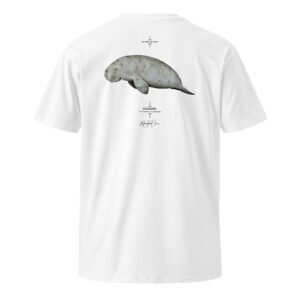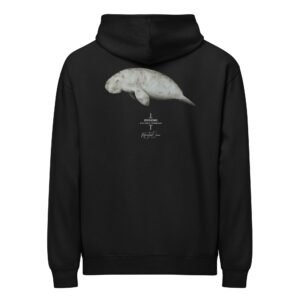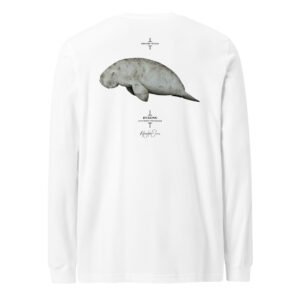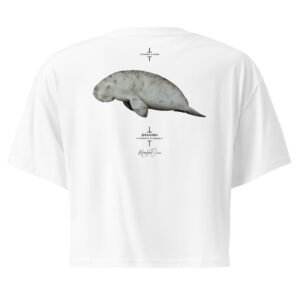
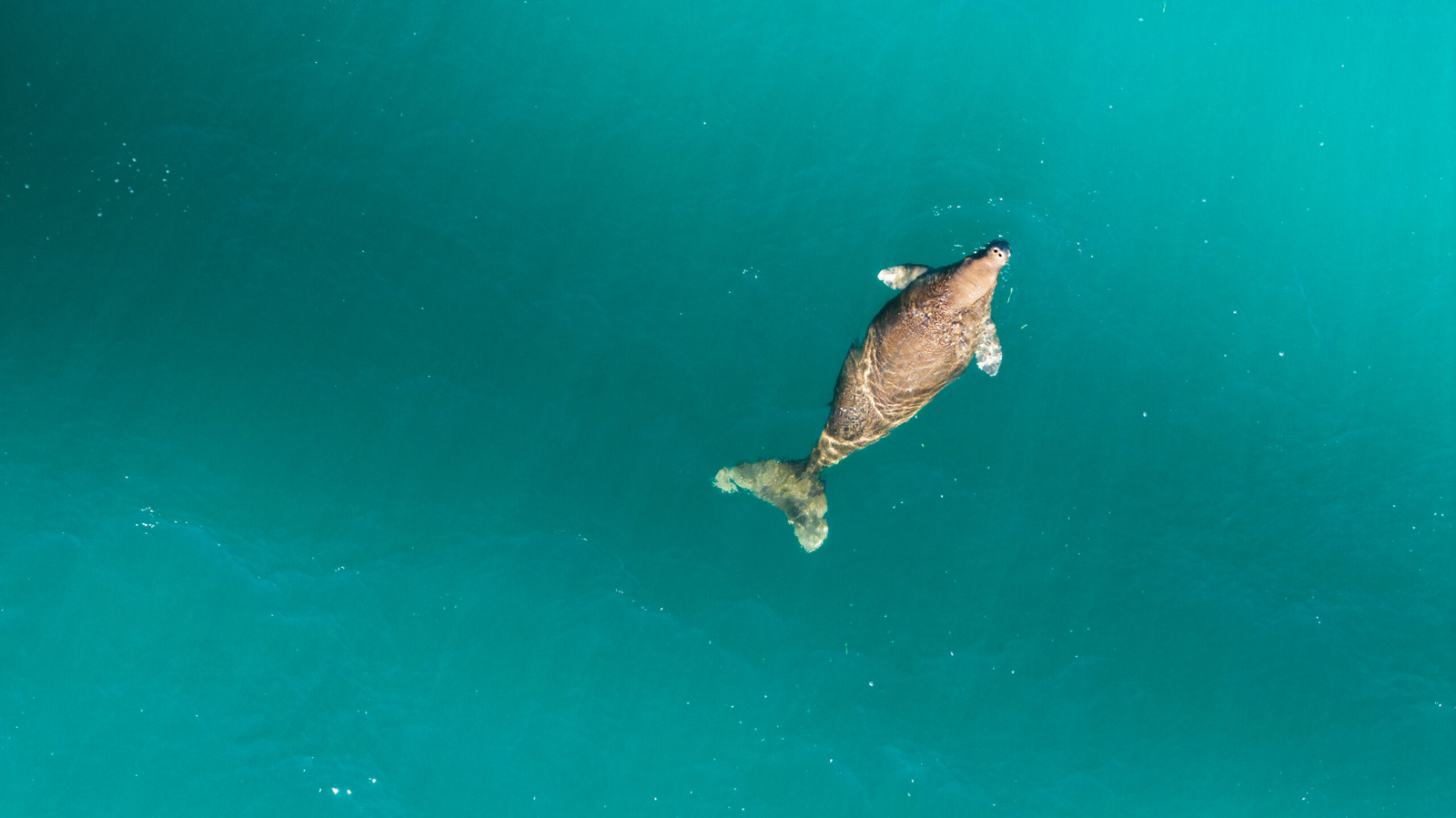
There is a quiet animal grazing the seagrass meadows of northern Australia that most people never get to see. It has a face like a whiskered vacuum cleaner, a tail like a whale’s and a family tree that leads back to elephants. It is the dugong, and it is one of the reasons we started making art for the ocean.
This post covers the science behind the dugong, the artist who brought our Dugong design to life, and the not-for-profit that every Dugong purchase helps support.
Meet the dugong (Dugong dugon)
Dugongs are marine mammals found in warm, shallow coastal waters across the Indo-Pacific, from East Africa and the Red Sea through Southeast Asia to the Pacific Islands. Australia is their global stronghold. The waters of Shark Bay, the Kimberley, the Northern Territory, the Torres Strait and the Great Barrier Reef hold the largest populations left anywhere on Earth.
Adults grow to around three metres and can weigh more than 400 kilograms. They can live for 70 years or more, which puts them among the longest-lived mammals in the sea.
An elephant in the ocean: how dugongs evolved
Dugongs belong to a group called the Sirenia, or sea cows, along with the three species of manatee. Their closest living relatives on land are not seals or whales. They are elephants and the small, rabbit-sized hyraxes of Africa and the Middle East.
Around 50 million years ago, the ancestors of sirenians were four-legged plant eaters living along the shores of the ancient Tethys Sea. Fossils such as Pezosiren portelli, found in Jamaica, show an animal that could walk on land but spent much of its life wading and feeding in shallow water. Over millions of years the back legs disappeared, the front legs became paddle-like flippers and the tail flattened into a fluke.
The dugong is now the only surviving member of its family, the Dugongidae. Its closest relative, the enormous Steller’s sea cow of the North Pacific, grew to around eight metres. It was described by European explorers in 1741 and hunted to extinction within about 27 years. That history is a hard reminder of how quickly a slow, gentle grazer can disappear.
Built for grazing
Almost everything about a dugong’s body is designed around one food source: seagrass.
- A downturned snout. The dugong’s muzzle points down towards the seafloor, with a horseshoe-shaped, bristly upper lip that grips and tears up seagrass. They often pull up whole plants, roots and all, leaving winding “feeding trails” through the meadow.
- Heavy bones. Dugong ribs and skeleton are unusually dense, which acts as ballast and helps them stay low over the seagrass without fighting their own buoyancy.
- A whale-like tail. Unlike the round, paddle-shaped tail of a manatee, a dugong has a fluked tail like a dolphin. It is the easiest way to tell the two apart.
- Big appetites. An adult can eat tens of kilograms of seagrass a day, and they surface to breathe every few minutes while they feed.
That constant grazing is good for the meadow. Like a lawnmower, it encourages fresh, nutritious regrowth, keeps the meadows diverse and moves nutrients through the system. Healthy dugong populations are a sign of healthy seagrass, and healthy seagrass stores carbon, protects coastlines and works as a nursery for fish, prawns and turtles.
A slow life, and why that matters
Dugongs breed slowly. Females usually do not have their first calf until they are around ten years old. Pregnancy lasts roughly 13 to 14 months, they have a single calf, and the calf stays close to its mother for up to two years. A female may only breed every three to seven years.
That means a population cannot bounce back quickly from losses. When a marine heatwave hit Shark Bay in 2011, it wiped out a large area of seagrass and dugongs were forced to move or go hungry. Floods and cyclones on the east coast have caused similar seagrass die-offs. Add boat strikes, entanglement in nets, coastal development and pollution, and it is easy to see why the dugong is listed as Vulnerable globally, with some populations outside Australia now critically low.
The artist: Ryan Chadwick
Our Dugong design was drawn by Ryan Chadwick, a UK-based wildlife artist known for his minimalist, highly detailed illustrations. Ryan strips away everything that might distract from the animal and focuses on the features that make each species unique, from the texture of the skin to the smallest details of its anatomy.
His fascination with animals started with the wildlife documentaries he grew up watching, and that love of the natural world runs through all of his work. The result is art that feels scientifically grounded but timeless, and gives overlooked species like the dugong the attention they deserve. Ryan has also illustrated our Oceanic Manta Ray, Orca and Right Whales designs.
40% of the profits from this design go directly to Ryan.
The cause: ORRCA
Every Dugong purchase supports ORRCA, the Organisation for the Rescue and Research of Cetaceans in Australia. ORRCA is a volunteer organisation dedicated to the rescue, research, conservation and welfare of Australia’s marine mammals.
Working along the east coast of Australia, ORRCA’s trained volunteers respond to whales, dolphins, seals and dugongs that are injured, stranded or entangled. They run a 24/7 marine mammal rescue hotline and work alongside government agencies, scientists, vets and local communities whenever an animal is in trouble.
Their work goes beyond individual rescues. Every callout adds to what we know about marine mammal populations and the threats they face, and ORRCA trains communities so more people know what to do when they find an animal in distress.
Shop the Dugong collection
Wear the dugong and help protect it. 40% of profits from this design go directly to the artist, and 30% of Return to the Ocean’s profits are donated to ocean conservation.