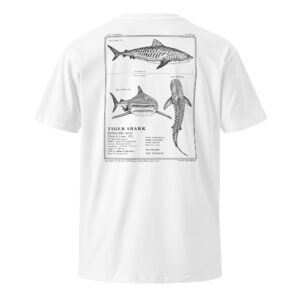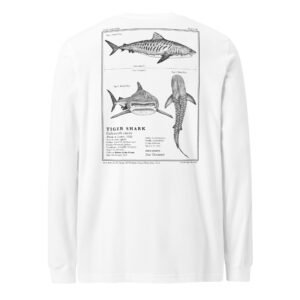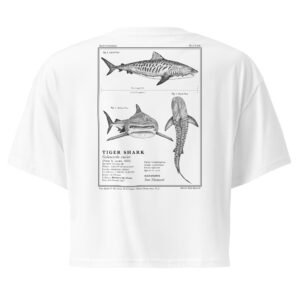
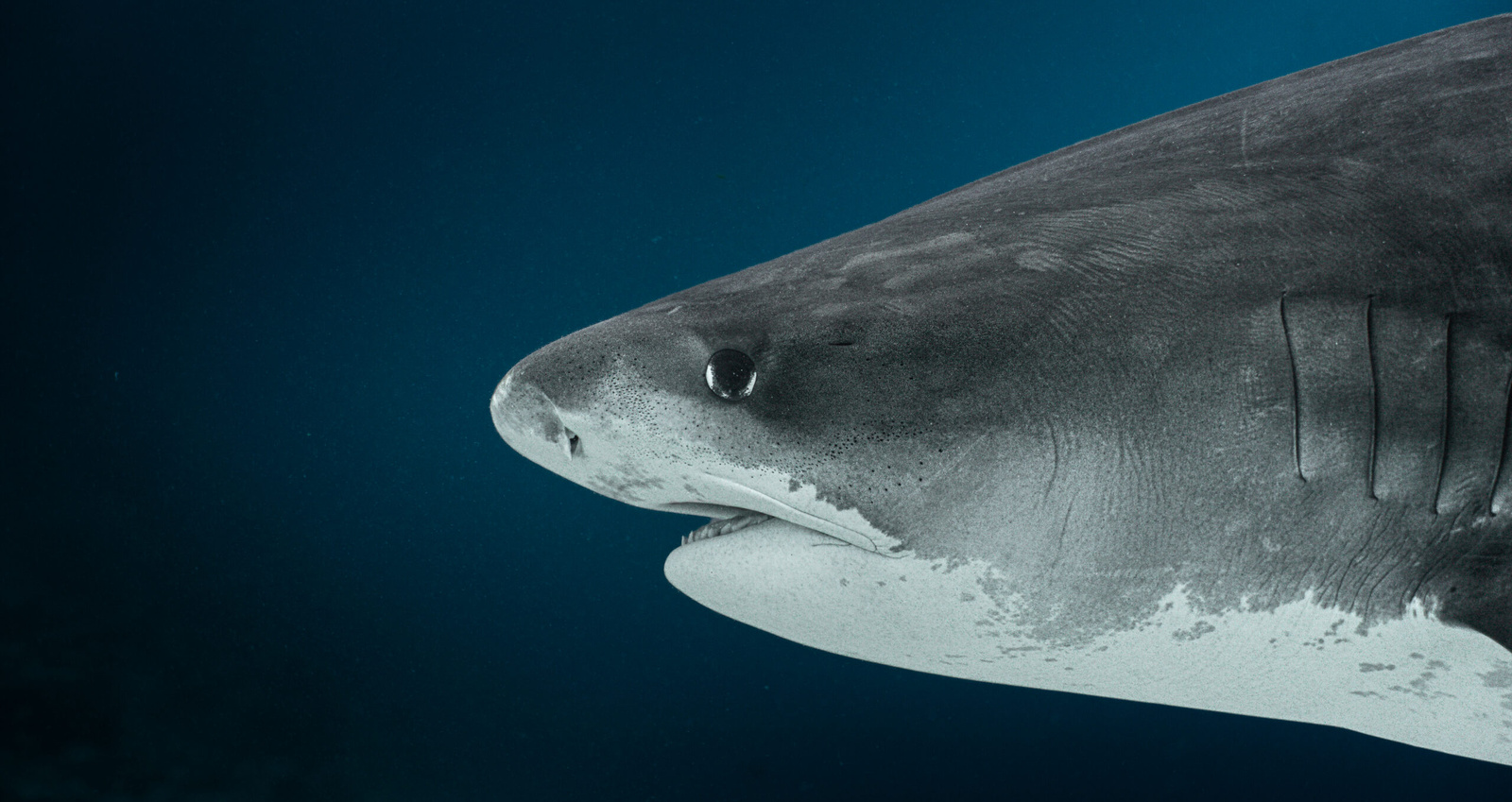
If there is one animal at the heart of Return to the Ocean, it is the tiger shark. We have spent countless hours in the water with them in Fuvahmulah in the Maldives, and every dive reminds us how wrong their reputation is. They are curious, intelligent and one of the most important predators in the ocean.
Our Tiger Shark design is the first in our Scientific Plate Series, celebrating the species, science and history behind some of the ocean’s most fascinating predators. Here is the science behind the tiger shark, the artist who drew it, and the research project your purchase supports.
Meet the tiger shark (Galeocerdo cuvier)
Tiger sharks are one of the largest predatory sharks in the ocean. Adults commonly reach three to four metres, and large females can grow beyond five metres and weigh more than 600 kilograms. They are found in tropical and warm temperate waters around the world, from coastal reefs and seagrass beds to the open ocean.
Their name comes from the dark vertical stripes along their sides. These are bold and clear in young sharks, then fade as they grow, so large adults can look almost plain grey.
A lineage all of its own
The tiger shark is the only living species in its genus, Galeocerdo. Fossil teeth from extinct relatives show that tiger sharks have been around for tens of millions of years, making them an ancient and distinctive branch of the shark family tree.
Traditionally they were grouped with the requiem sharks, alongside bull sharks, reef sharks and blue sharks. More recent genetic studies have found they are different enough that many scientists now place them in their own family, the Galeocerdonidae.
Biology of an ocean generalist
- Teeth like can openers. Tiger shark teeth are broad, curved and heavily serrated, with a deep notch on one side. They are built to saw through tough prey, including the shells of sea turtles.
- An appetite for almost anything. Tiger sharks are famous generalists. Their diet includes fish, rays, sea turtles, sea snakes, seabirds, dugongs, crustaceans and other sharks. They are also known to scavenge, which has given them a reputation as the “garbage cans of the sea”.
- Built for low light. Like many sharks, tiger sharks have a reflective layer behind the retina, called the tapetum lucidum, that helps them see in dim water. They often hunt at dawn, dusk and night.
- Unique reproduction. Tiger sharks give birth to live pups, but without a placenta. The pups develop inside eggs within the mother and are nourished by yolk and fluid. Litters are large, often 10 to 80 pups.
- Long-distance travellers. Satellite tags show that some tiger sharks travel thousands of kilometres, crossing ocean basins and returning to the same places year after year.
Guardians of the seagrass
Tiger sharks do more than eat. Research in Shark Bay, Western Australia, has shown that their presence changes how other animals behave. When tiger sharks are around, dugongs and green turtles avoid grazing in the most exposed, shallow seagrass beds and move around more. That spreads grazing pressure across the meadows and stops any one area being overgrazed.
Scientists call this the landscape of fear, and it shows how apex predators protect whole ecosystems. Healthy tiger shark populations mean healthy seagrass, and healthy seagrass means more fish, more carbon stored and better protection for coastlines.
Why they need protection
Tiger sharks are caught around the world in commercial fisheries, as bycatch and in shark control programs. Their fins, skin, meat and liver oil are all used. They mature slowly, and while their litters can be large, populations take time to recover. The species is listed as Near Threatened on the IUCN Red List, and declines have been recorded in several regions.
Places like Fuvahmulah, where tiger sharks can be seen year-round, are vital for understanding and protecting them, and show that a living shark can be worth far more to a community than a dead one.
The artist: Kayla Racanelli
Our Tiger Shark design was created by Kayla Racanelli, an artist based in Hawaii. Kayla works in dotwork, building the entire design from thousands of individual dots to create depth, texture and movement.
The piece is grounded in real animals. Kayla worked from underwater photography by Jake Mason and Sina Ritter, so the shark you see is drawn from the actual tiger sharks we dive with. That attention to real detail, paired with Kayla’s meticulous style, turns a photograph into a piece of wearable art. As the first design in our Scientific Plate Series, it also draws inspiration from the scientific history of the tiger shark, combining detailed artwork with educational elements.
40% of the profits from this design go directly to Kayla.
The cause: the Miyaru Project
Every Tiger Shark purchase supports the Miyaru Project, a Maldivian NGO dedicated to shark and ray research and conservation. Miyaru is based in Fuvahmulah, one of the few places on Earth where tiger sharks are reliably encountered year-round.
Miyaru’s researchers use non-invasive tools such as ultrasound imaging to study tiger shark reproductive biology, and deploy deep-sea cameras in partnership with the National Geographic Exploration Technology Lab to track populations in areas newly exposed to fishing pressure. Their work is community-driven, built on collaboration between local Maldivian communities and international scientists.
In 2026, Miyaru opened the Maldives’ first Shark Research and Conservation Hub in Fuvahmulah, a dedicated space for research, education and citizen science.
Shop the Tiger Shark collection
Wear the tiger shark and help protect it. 40% of profits from this design go directly to the artist, and 30% of Return to the Ocean’s profits are donated to ocean conservation.