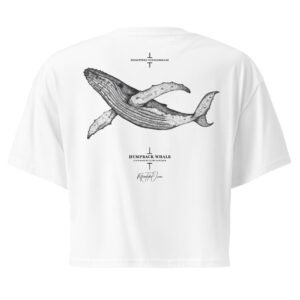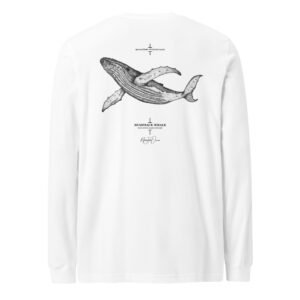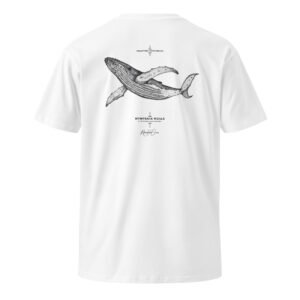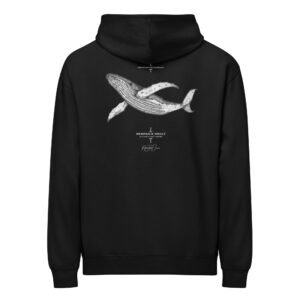
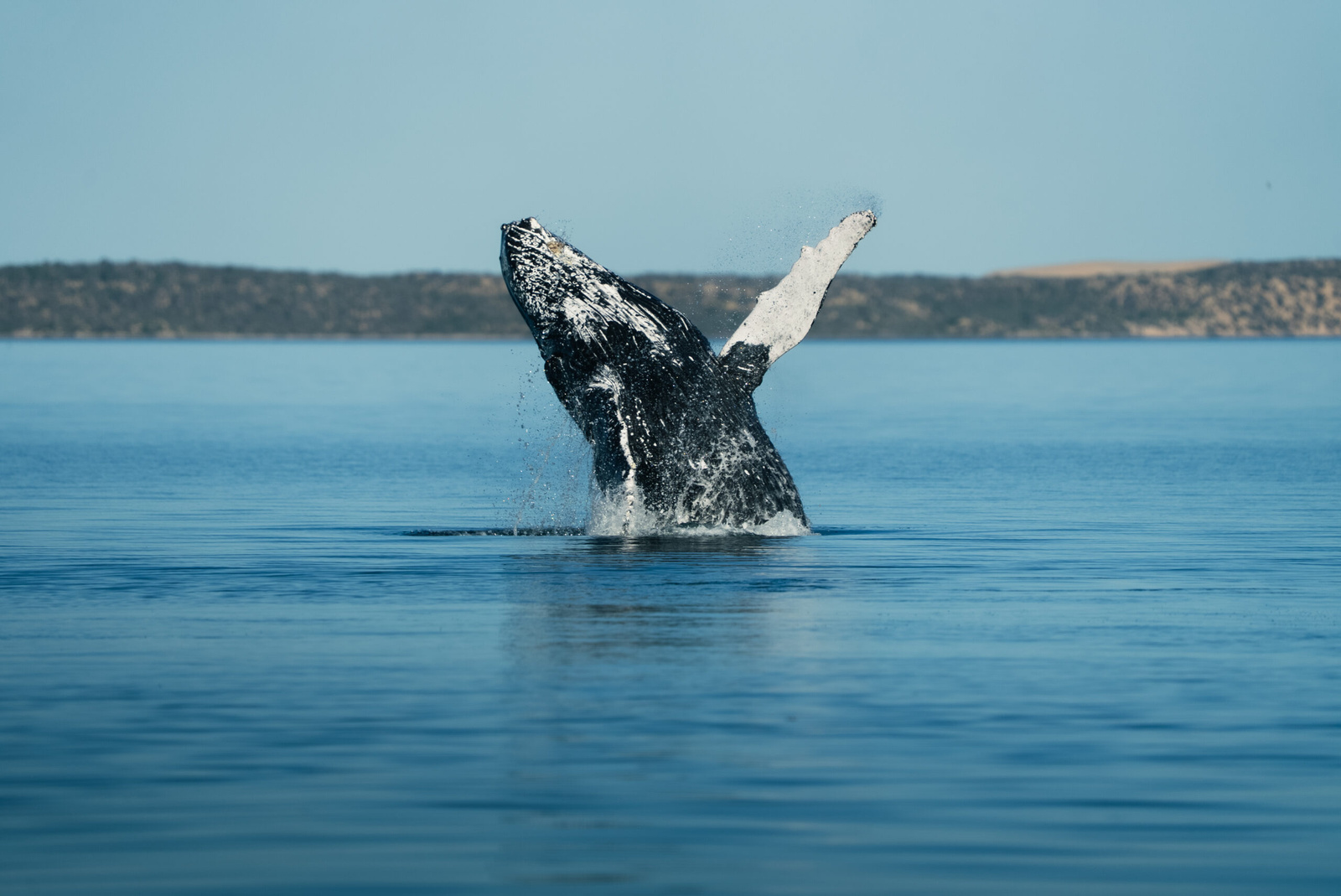
Every winter, tens of thousands of humpback whales travel up the coasts of Australia. They breach, slap their fins, sing and nurse their calves in warm water before heading back to Antarctica to feed. For many of us, seeing a humpback for the first time is the moment we fall in love with the ocean.
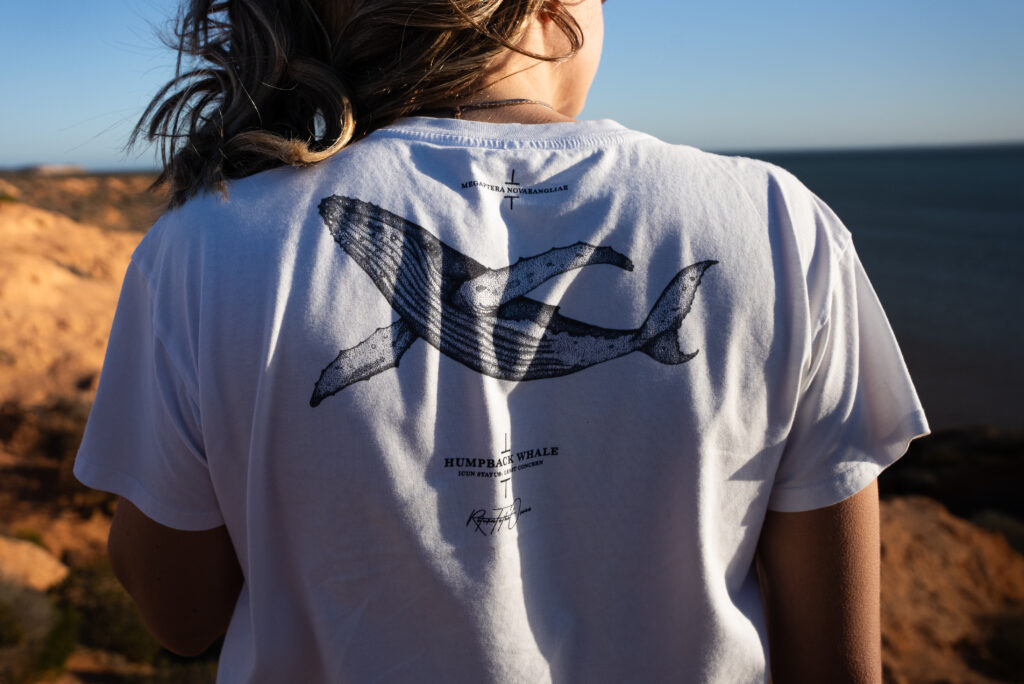
This post dives into the science of the humpback whale, the artist behind our Humpback Whale design, and the research nonprofit your purchase supports.
Meet the humpback whale (Megaptera novaeangliae)
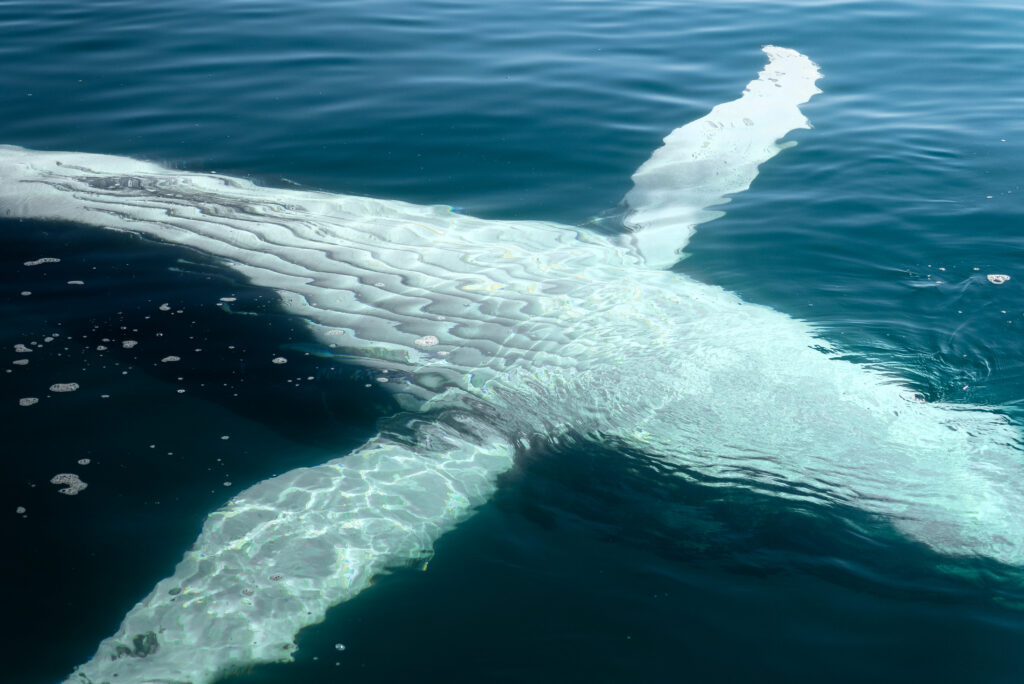
Humpbacks are baleen whales, a member of the rorqual family alongside blue, fin and minke whales. Adults reach around 14 to 16 metres and weigh up to 30 tonnes or more. Their scientific name means “big wing of New England”, a nod to their enormous pectoral fins. At up to five metres long, roughly a third of their body length, they are the longest flippers of any whale.
The name humpback comes from the way they arch their back high out of the water just before a deep dive.
From land to sea: how whales evolved
It is hard to believe looking at a 30-tonne humpback, but whales evolved from small, hoofed land mammals. Around 50 million years ago, animals like Pakicetus, a dog-sized creature living near the shores of what is now Pakistan, started spending more time in the water. Over roughly ten million years their descendants lost their back legs, developed a powerful tail and moved their nostrils to the top of the head to become the blowhole.
Today, the closest living relatives of whales on land are hippos.
Later, around 30 million years ago, one branch of whales swapped teeth for baleen, plates made of keratin (the same material as your fingernails) that hang from the upper jaw and work like a giant sieve. That shift let whales feed on huge swarms of krill and small fish, and paved the way for the giants we see today.
Biology that still surprises scientists
- Bubble-net feeding. Humpbacks have one of the most creative hunting methods in the ocean. A group will swim in a spiral below a school of fish or krill while blowing bubbles, creating a curtain that traps the prey. Then they lunge up through the middle with their mouths wide open.
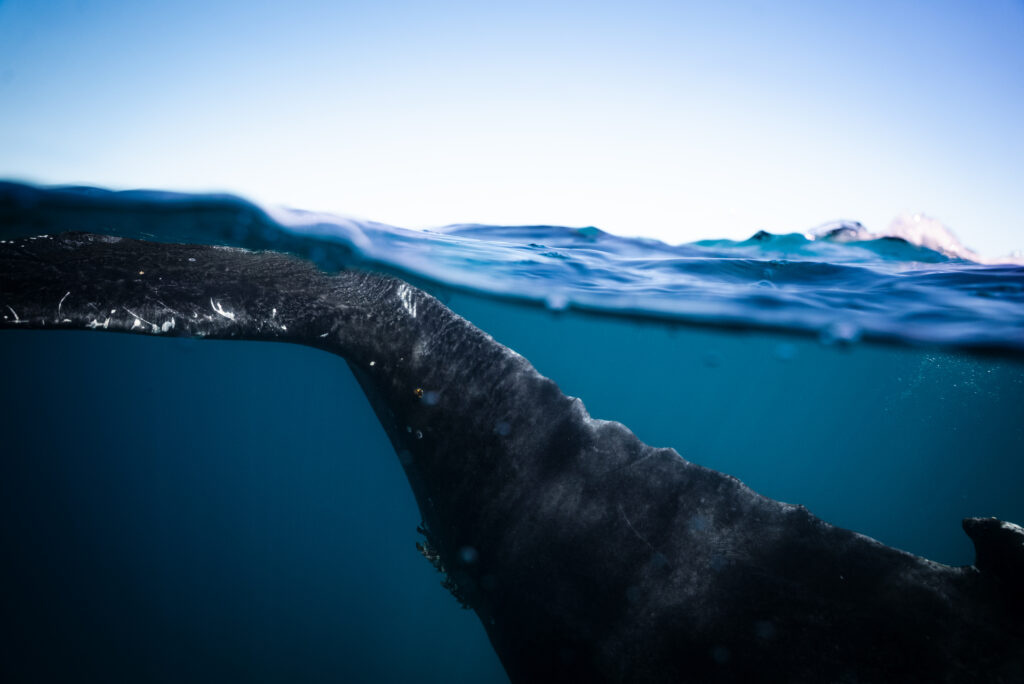
- Flippers that inspired engineers. The leading edge of a humpback’s flipper is covered in bumps called tubercles. These help the whale turn tightly at low speed, and the idea has since been copied in the design of wind turbine and fan blades.
- Unique tails. The pattern on the underside of each humpback’s tail fluke is unique, like a fingerprint. Researchers use photos of flukes to track individual whales across oceans and decades.
- Epic migrations. Some humpback populations travel more than 5,000 kilometres each way between feeding and breeding grounds, one of the longest migrations of any mammal. They barely eat while they are away from their feeding grounds, living off their blubber for months.
The song of the humpback
Male humpbacks sing long, complex songs made up of repeating themes, and a single song session can go on for hours. In 1971, biologists Roger Payne and Scott McVay published research showing that these sounds were structured songs. Recordings of humpback song went on to become a bestselling album and helped spark the global Save the Whales movement.
What is even more remarkable is that the song changes over time, and all the males in a population change it together. Researchers have tracked new songs spreading across the South Pacific from east Australian whales to populations thousands of kilometres away, like a hit single moving between countries. It is one of the clearest examples of cultural transmission in any animal outside of humans.
A conservation comeback
Commercial whaling pushed humpbacks to the edge. Some populations were reduced to just a few hundred animals by the time hunting was banned in the 1960s. Since then, many populations have made a spectacular recovery, including the humpbacks that migrate along both the east and west coasts of Australia.
That recovery shows what protection can do, but the work is not finished. Humpbacks still face entanglement in fishing gear, ship strikes, ocean noise and changes in krill populations as the Southern Ocean warms.
The artist: Sophie Browne
Our Humpback Whale design was created by Sophie Browne, an artist based in Western Australia. Sophie works in dotwork, building the entire design from thousands of individual dots to create depth, texture and movement.
This piece was not drawn from a reference photo. It came from memory and imagination, shaped by Sophie’s own time on the water along the Ningaloo Coast, in Coral Bay and Exmouth, where humpbacks pass on their annual migration. That lived familiarity with the coast, paired with her meticulous style, gives the artwork the feeling of real, moving water.
40% of the profits from this design go directly to Sophie.
The cause: Ocean Alliance
Every Humpback Whale purchase supports Ocean Alliance, a nonprofit dedicated to whale research and ocean conservation. It was founded in 1971 by Dr Roger Payne, the same biologist whose work revealed the songs of the humpback whale.
Ocean Alliance is known for innovation. Its SnotBot program uses drones to fly through a whale’s blow and collect samples of the spray, giving scientists data on the whale’s health, hormones and DNA without ever touching or disturbing the animal. Its work also includes some of the longest-running whale population studies in the world, research that feeds directly into how humpbacks and other great whales are protected today.
Shop the Humpback Whale collection
Wear the humpback and help protect it. 40% of profits from this design go directly to the artist, and 30% of Return to the Ocean’s profits are donated to ocean conservation.