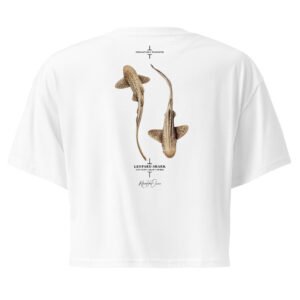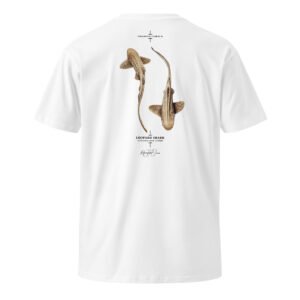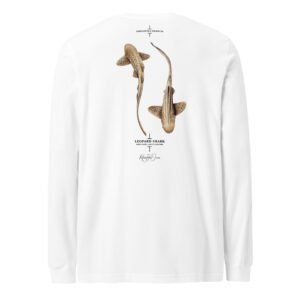
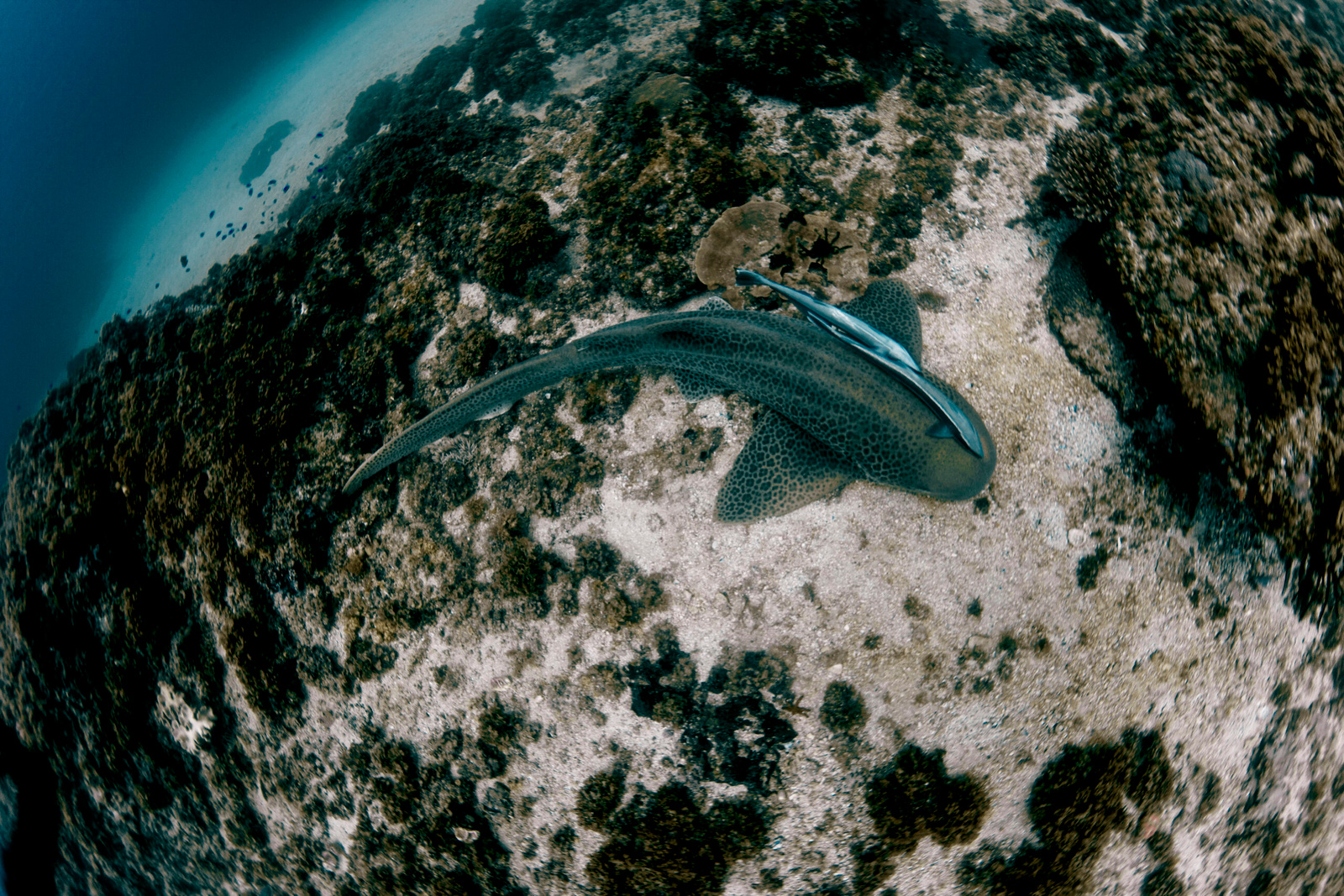
If you have ever seen a leopard shark resting on the sand, you will know how calm and beautiful these animals are. With their long tails, ridged bodies and golden, spotted skin, they look nothing like the “typical” shark most people imagine. They are also a species in serious trouble, and one of the focus animals for one of the most ambitious shark recovery projects in the world.
Here is the science behind the leopard shark, the artist who drew our design, and the conservation program your purchase helps support.
Meet the leopard shark (Stegostoma tigrinum)
The leopard shark, also called the zebra shark, lives in tropical waters of the Indo-Pacific, from East Africa and the Red Sea through Southeast Asia to northern Australia and the western Pacific. In Australia they are a favourite with divers in places like Byron Bay’s Julian Rocks, where they gather during summer, and along the Queensland and Western Australian coasts.
Adults grow to around two and a half metres, and almost half of that length is tail. They spend much of their day resting on sandy bottoms near reefs, often facing into the current, then become more active at night.
You might also see them listed under the older scientific name Stegostoma fasciatum. In 2019, scientists confirmed that the name Stegostoma tigrinum was the correct one, which is why newer references use it.
Born a zebra, grows up a leopard
One of the most fascinating things about this species is that it changes completely as it grows. Juveniles are dark brown to black with bold yellow or white stripes, which is where the name “zebra shark” comes from. Some scientists think that striped pattern may help young sharks mimic venomous sea snakes and avoid predators.
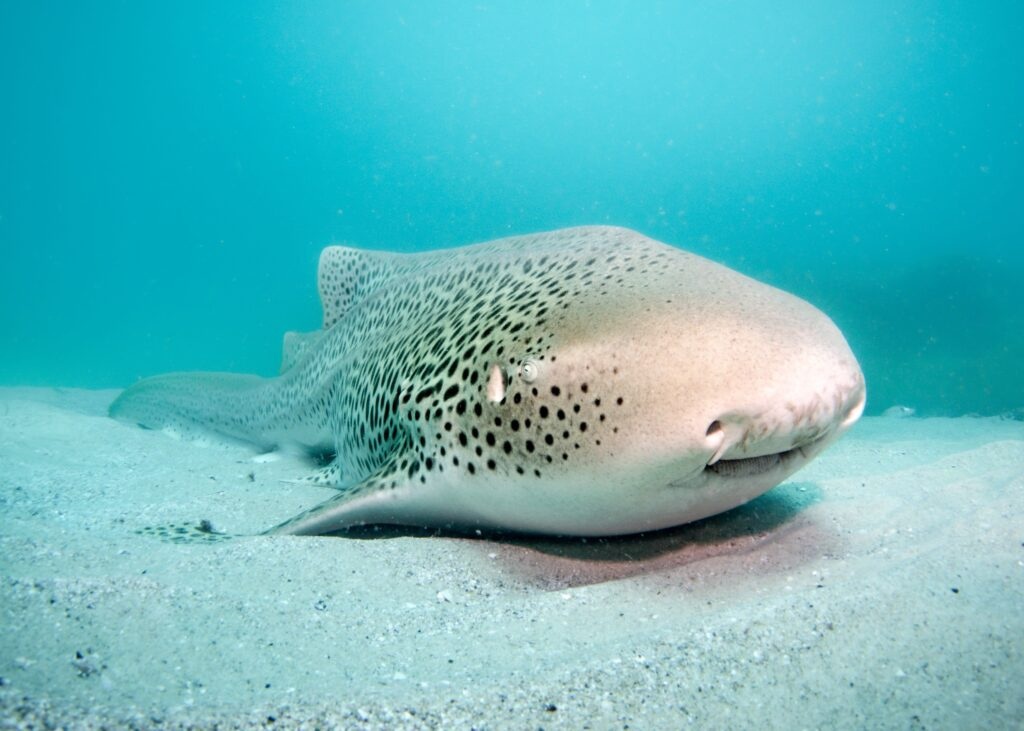
As they grow, the stripes break up into spots, and adults end up pale yellow-brown covered in small dark spots. That is why most of the world now knows them as leopard sharks.
Where they sit in the shark family tree
Leopard sharks belong to the order Orectolobiformes, the carpet sharks. It is a group of mostly bottom-dwelling sharks that includes wobbegongs, nurse sharks, bamboo sharks and, surprisingly, the biggest fish in the ocean, the whale shark. The leopard shark is the only living member of its own family, the Stegostomatidae.
Carpet sharks are an ancient lineage, with a fossil record going back well over 150 million years to the time of the dinosaurs. Many share features that suit a life on the seafloor, such as small mouths positioned at the front of the head and fleshy barbels near the nostrils that help them sense prey.
Built for the seafloor
- Ridged bodies. Adults have prominent ridges running along their bodies, giving them a distinctive, almost armoured look.
- Suction feeding. Leopard sharks eat molluscs, crustaceans, small fish and sea snakes. They use their flexible bodies to wriggle into cracks in the reef and suck prey out of crevices.
- Breathing at rest. Unlike sharks that must keep swimming, leopard sharks can pump water over their gills while lying still on the bottom, which is why you often see them so relaxed on the sand.
- Eggs, not live young. Female leopard sharks lay large, dark egg cases with tufts of fibres that anchor them to the reef until the pups hatch.
A shark that can reproduce on its own
Leopard sharks made headlines when a female at an aquarium in Townsville, Queensland, produced healthy young after years without any contact with a male. Scientists confirmed this was parthenogenesis, a rare form of reproduction where an egg develops without being fertilised. It has since been recorded in other leopard sharks in aquariums too. Researchers are still working out how often, if ever, this happens in the wild, but it shows just how much we have left to learn about sharks.
Why they need help
Despite how widespread they once were, leopard sharks have declined sharply across much of their range. They live in shallow coastal waters where fishing pressure is intense, and they are caught in nets and trawls for their meat, fins and liver oil. Their slow growth and low reproductive rate mean populations struggle to recover. The species is now listed as Endangered on the IUCN Red List, and in some places, such as parts of Indonesia, it had become locally extinct or nearly so.
The artist: Johanna Excell
Our Leopard Shark design was created by Johanna Excell. Johanna’s illustration celebrates the leopard shark’s distinctive markings and sleek form, turning a misunderstood shark into a wearable reminder that healthy oceans need thriving shark populations. For Johanna, this piece is about admiration over fear and protecting what keeps our seas in balance.
[JAKE TO ADD: a few lines about Johanna, such as where she is based, her medium and style, and her connection to leopard sharks or the ocean.]
40% of the profits from this design go directly to Johanna.
The cause: ReShark
Every Leopard Shark purchase supports ReShark, a global conservation initiative working to protect and restore shark and ray populations. ReShark brings together a large coalition of aquariums, researchers, conservation groups and governments, all working towards one goal: putting sharks and rays back into the places where they have disappeared.
Its first major project focuses on the leopard shark itself. Through the StAR Project (Stegostoma tigrinum Augmentation and Recovery), eggs from leopard sharks in aquariums around the world are hatched and the young sharks are raised and released into the reefs of Raja Ampat, Indonesia, where the wild population had collapsed. Released sharks are monitored to track how they survive, grow and settle in.
It is one of the first efforts of its kind for sharks, and a powerful example of what is possible when aquariums, scientists and local communities work together.
Shop the Leopard Shark collection
Wear the leopard shark and help bring it back. 40% of profits from this design go directly to the artist, and 30% of Return to the Ocean’s profits are donated to ocean conservation.