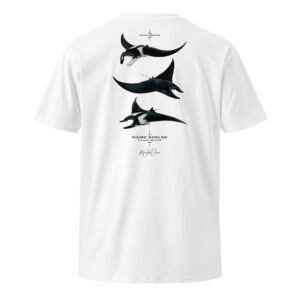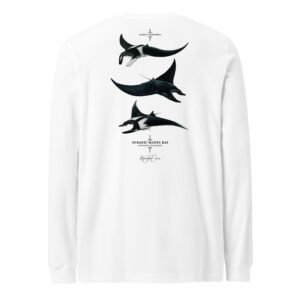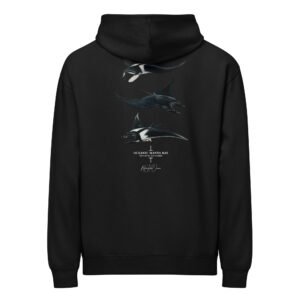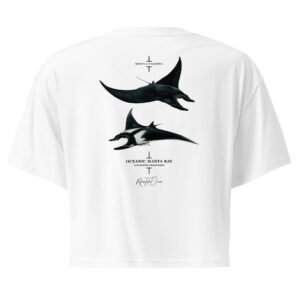

Seeing an oceanic manta ray for the first time is something you never forget. A seven-metre-wide shadow appears out of the blue, banks gently and turns to look at you. Few animals in the ocean seem so curious about us, or so effortless in the water.
Here is the science behind the oceanic manta ray, the artist who drew our design, and the charity your purchase helps support.
Meet the oceanic manta ray (Mobula birostris)
The oceanic manta is the largest ray in the world, with a wingspan, properly called a disc width, of up to around seven metres. It roams the open ocean in tropical and subtropical waters worldwide, visiting offshore islands, seamounts and coastlines where food is concentrated.
“Manta” comes from the Spanish word for cloak or blanket, a nod to the sweeping shape of their bodies.
For a long time, scientists thought there was just one species of manta. In 2009, research showed there were actually two: the smaller reef manta (Mobula alfredi), which tends to stay around coastal reefs, and the larger oceanic manta, which travels further offshore. Then in 2018, genetic studies showed mantas sit inside the same group as devil rays, so both were moved into the genus Mobula. The science of mantas is still being written.
From sharks to flying rays: manta evolution
Rays and sharks share a common ancestor, but rays split off more than 200 million years ago and flattened out, with their pectoral fins fusing to the sides of their head to form wings. Many rays still live on the seafloor, but mantas and their relatives took a different path. They left the bottom behind, took to open water and became “flying” filter feeders.
Mantas are closely related to eagle rays and cownose rays. Along the way, they lost the venomous tail spine that stingrays are known for. Despite the family resemblance, mantas cannot sting at all. They are completely harmless.
Biology of a gentle giant
- Filter feeding. Mantas feed on zooplankton, filtering huge volumes of water through specialised gill plates. When feeding, they unroll two fleshy flaps on the front of their head, the cephalic fins, which funnel water and food into their mouth. When rolled up, these look like horns, which is where the old name “devil ray” came from.
- Big brains. Manta rays have one of the largest brain-to-body size ratios of any fish. In aquarium studies, mantas have responded to mirrors in ways that some researchers think hint at self-awareness, a behaviour usually associated with apes, dolphins and elephants.
- Fingerprint bellies. The pattern of dark spots on a manta’s white underside is unique to each individual and stays the same for life. Photo-identification of these patterns is how researchers track mantas over years and across oceans.
- Diving deep. Despite being associated with the surface, oceanic mantas regularly dive hundreds of metres, and tagged mantas have been recorded at depths beyond 1,000 metres.
- Cleaning stations. Mantas regularly visit reef “cleaning stations”, where small fish pick parasites and dead skin off their bodies. These are often the best places for divers to see them.

A slow life in a fast-changing ocean
Oceanic mantas live long, slow lives. They may take a decade or more to mature, and females usually give birth to a single pup after a pregnancy of around a year, often only every two to five years. That makes them extremely vulnerable to fishing.
The biggest threat is the international trade in manta and devil ray gill plates, which are sold in some markets as a traditional remedy, despite there being no evidence they have medicinal value. Mantas are also caught as bycatch and face threats from boat strikes, entanglement and plastic pollution.
The oceanic manta is listed as Endangered on the IUCN Red List. Where they are protected, though, mantas can be worth far more alive. In places like the Maldives, Indonesia and Mexico, manta tourism supports local livelihoods and gives communities a strong reason to protect them.
The artist: Ryan Chadwick
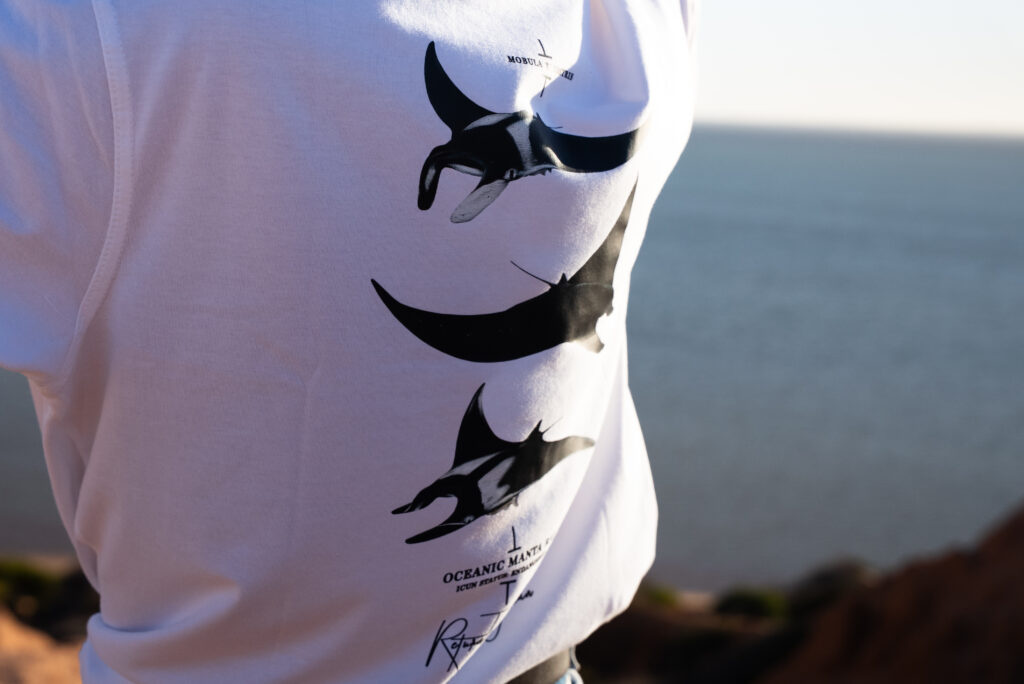
Our Oceanic Manta Ray design was drawn by Ryan Chadwick, a UK-based artist. Ryan brought this manta to life in pencil, building the design entirely from layered graphite with the fine, patient detail that has become his signature across his bird and marine life work.
Rather than working from a photograph, this piece came straight from Ryan’s own hand and eye. That ability to render an animal so precisely from memory, paired with his meticulous eye for detail, gives the artwork its almost photographic depth. Ryan has also illustrated our Dugong, Orca and Right Whales designs.
40% of the profits from this design go directly to Ryan.

The cause: the Manta Trust
Every Oceanic Manta Ray purchase supports the Manta Trust, a UK-based charity founded in 2011. The Manta Trust coordinates manta ray research and conservation through a global network of affiliate projects in more than 20 countries.
Its work centres on long-term population studies, tracking individual mantas over many years to understand their movements, breeding and the threats they face. That science directly informs the protections governments put in place. The Manta Trust’s research was instrumental in securing international trade protections for manta rays under CITES in 2013, a major milestone for the species.
The Trust also works on education and sustainable tourism, helping make sure that the people who swim with mantas help protect them too.
Shop the Oceanic Manta Ray collection
Wear the manta and help protect it. 40% of profits from this design go directly to the artist, and 30% of Return to the Ocean’s profits are donated to ocean conservation.