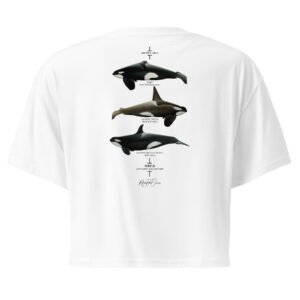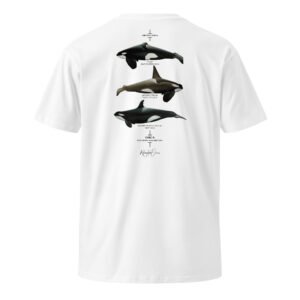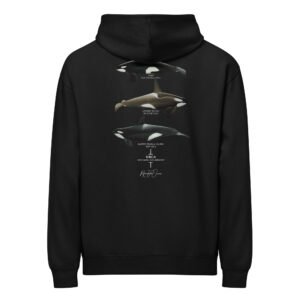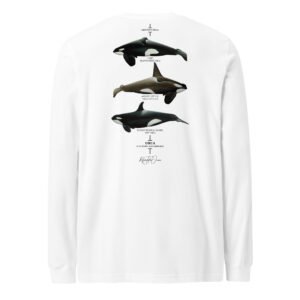
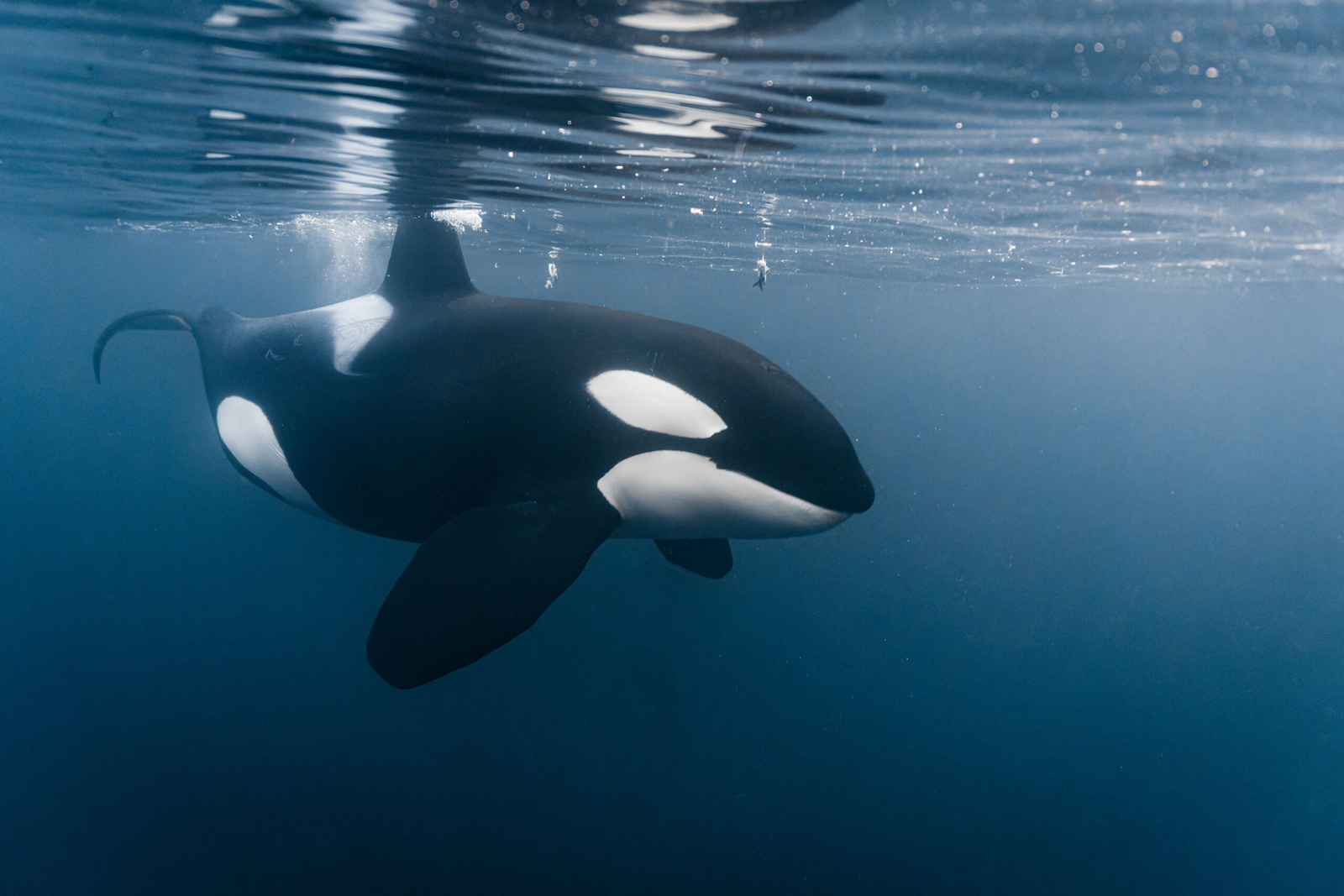
They are called killer whales, but orcas are not whales at all, at least not in the way most people think. They are the largest member of the dolphin family, and one of the most intelligent, social and adaptable animals on Earth. They live in every ocean, from the poles to the tropics, and right here off the Australian coast.
Here is the science behind the orca, the artist who drew our design, and the not-for-profit your purchase helps support.
Meet the orca (Orcinus orca)
Orcas are toothed whales, part of the dolphin family Delphinidae. Males can reach around eight to nine metres and weigh up to six tonnes, with a tall, straight dorsal fin that can stand nearly two metres high. Females are smaller, with a curved dorsal fin. Each orca has a unique grey “saddle patch” behind its dorsal fin and distinctive nicks and scars on the fin itself, which researchers use to identify individuals.
They are the most widely distributed marine mammal in the world, found in every ocean.
How orcas evolved
Like all whales and dolphins, orcas descend from four-legged land mammals that took to the water around 50 million years ago. The toothed whales, which include dolphins, porpoises, sperm whales and beaked whales, went on to develop echolocation: they produce clicks and listen to the echoes to “see” their surroundings and find prey, even in dark or murky water.
Ocean dolphins diversified much more recently, over the last ten or so million years, and the orca is now the only living member of its genus. Genetic studies suggest modern orca populations spread around the world relatively recently, then split into distinct groups that specialise in different prey.

Ecotypes: different cultures, different diets
One of the most remarkable things about orcas is that not all orcas are the same. Scientists recognise several ecotypes, groups that look slightly different, eat different food, behave differently and rarely, if ever, interbreed.
In the North Pacific, for example, “resident” orcas eat almost nothing but fish, especially salmon, while “Bigg’s” orcas (also called transients) hunt seals, sea lions and other marine mammals. They can share the same waters and still ignore each other. In Antarctica, different types specialise in everything from fish to seals to penguins, with some using teamwork to create waves that wash seals off ice floes.
These are learned behaviours, passed down through generations. Each group also has its own set of calls, a vocal dialect, that young orcas learn from their families. Many scientists describe these differences as culture.
Families led by grandmothers
Orcas live in tight family groups called pods, often based around a mother and her offspring. In some populations, sons and daughters stay with their mothers for life.
Female orcas go through menopause, something known in only a handful of species, including humans and a few other toothed whales. Females can live into their 80s or older, long after they stop breeding. Research suggests these older females lead their families to food in lean times, sharing decades of knowledge about where and when to find prey. Grandmothers really do keep the family going.
Orcas in Australia
Australia has some incredible orca encounters. Every summer, a large gathering of orcas forms off Bremer Bay in Western Australia, where they hunt in the deep waters of the Bremer Canyon. Off Ningaloo, orcas are known to hunt humpback whale calves during the migration. In 2019, orcas off Western Australia were documented killing an adult blue whale, the first time this had ever been recorded.
On the east coast, the town of Eden in New South Wales has one of the most extraordinary stories in Australian history. In the late 1800s and early 1900s, a pod of orcas there worked alongside local whalers, herding baleen whales into the bay in exchange for a share of the catch. The skeleton of the most famous of them, “Old Tom”, can still be seen at the Eden Killer Whale Museum.
Threats
As top predators, orcas face threats that build up through the food chain. Chemical pollutants such as PCBs accumulate in their blubber and can affect their immune systems and ability to breed. Some populations are also struggling with declining prey, vessel noise and disturbance. The Southern Resident orcas of the Pacific Northwest, for example, number only around 75 animals and are listed as endangered.
Because orcas are split into so many distinct populations, the species as a whole is listed as Data Deficient on the IUCN Red List. Some groups are doing well, while others are in serious trouble.
The artist: Ryan Chadwick
Our Orca design was illustrated by Ryan Chadwick, a UK-based wildlife artist known for his meticulous, minimalist style. Ryan’s artwork captures the strength and presence of orcas: animals that move with intention, family bonds and an unmistakable energy. The design is a tribute to the wild places orcas roam and the ecosystems that support them.
Ryan has also illustrated our Dugong, Oceanic Manta Ray and Right Whales designs.
40% of the profits from this design go directly to Ryan.

The cause: ORRCA
Every Orca purchase supports ORRCA, the Organisation for the Rescue and Research of Cetaceans in Australia. ORRCA is a volunteer organisation dedicated to the rescue, research, conservation and welfare of whales, dolphins, seals and dugongs.
ORRCA’s trained volunteers respond to marine mammals that are injured, stranded or entangled along the east coast of Australia. They run a 24/7 rescue hotline and work alongside government agencies, scientists, vets and local communities whenever an animal is in distress. Every callout also adds to what we know about marine mammal populations and the threats they face, and ORRCA educates communities so more people know how to help.
Shop the Orca collection
Wear the orca and help protect the animals that share our coast. 40% of profits from this design go directly to the artist, and 30% of Return to the Ocean’s profits are donated to ocean conservation.