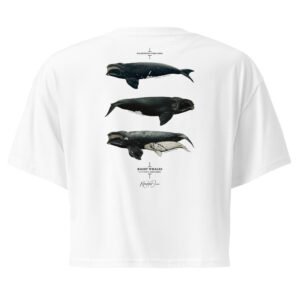
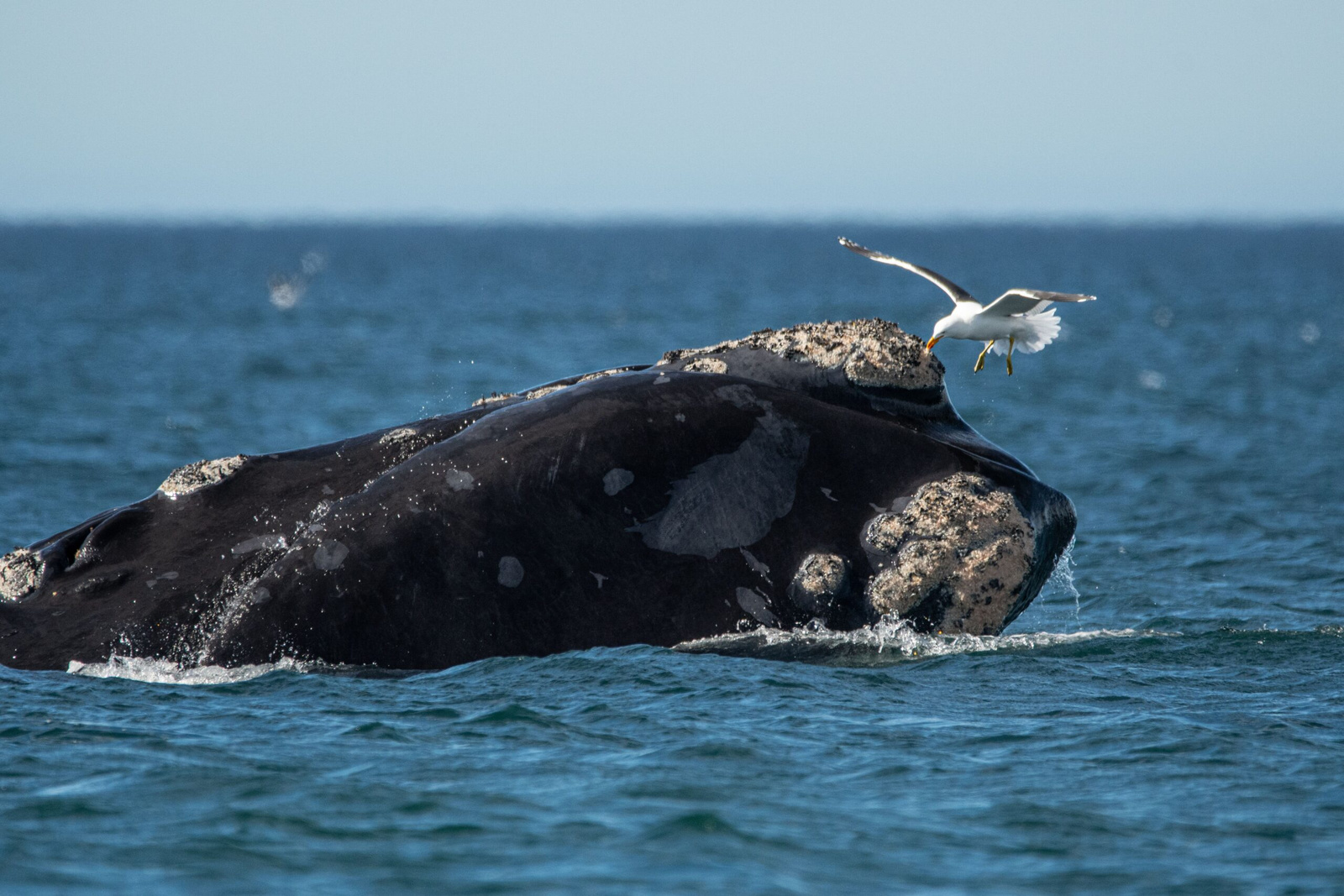
Right whales got their name for the worst possible reason. To early whalers, they were the “right” whale to hunt: slow, close to shore, rich in oil and baleen, and buoyant enough to float after they were killed. Centuries of hunting pushed all three species to the brink, and today they include some of the most endangered large whales on the planet.
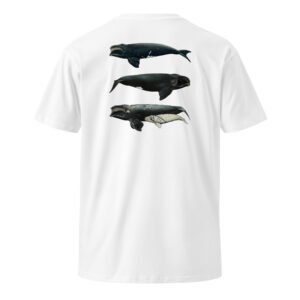
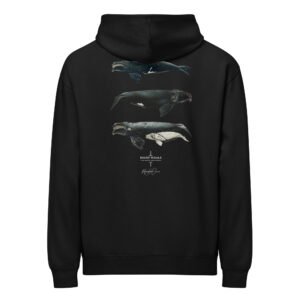
Our Right Whales design brings all three species together. Here is the science behind them, the artist who drew them, and the research nonprofit your purchase helps support.
Meet the right whales (genus Eubalaena)
There are three species of right whale:
- The Southern right whale (Eubalaena australis), found across the Southern Hemisphere, including the coasts of southern Australia.
- The North Atlantic right whale (Eubalaena glacialis), found off the east coast of North America.
- The North Pacific right whale (Eubalaena japonica), the least known, found in the North Pacific from Japan and Russia to Alaska.
All three are large, stocky baleen whales, reaching around 15 to 17 metres and weighing up to 60 tonnes or more. They have no dorsal fin, broad paddle-shaped flippers, and an enormous head that can make up around a quarter to a third of their body length. Their blow is V-shaped, which makes them easy to identify from a distance.
Evolution: an ancient family of skim feeders
Right whales belong to the family Balaenidae, which they share with the bowhead whale of the Arctic. Like all baleen whales, they descend from toothed ancestors that gave up their teeth for baleen, the keratin plates used to filter food from the water.
Balaenids are among the oldest surviving baleen whale lineages, with a fossil history going back well over ten million years. They took a different feeding path from rorquals like humpback and blue whales. Rather than lunging at prey, right whales are skim feeders. They swim slowly with their mouths open, filtering tiny copepods and krill through baleen plates that can be over two metres long, the longest of any whale except the bowhead.
Wearing their ID on their heads
Right whales have rough, raised patches of skin on their heads called callosities. They are found around the blowholes, above the eyes, on the chin and along the jaw. These patches look white or yellow because they are covered in colonies of tiny crustaceans called whale lice.
The pattern of callosities is unique to every whale, and researchers use aerial photos of them to identify individuals and track them throughout their lives. Much of what we know about right whale populations comes from decades of photographing these patterns.
Big, slow and surprising
- Huge mouths, tiny food. Right whales feed on copepods, crustaceans only a few millimetres long. They need to find dense patches of them to get enough energy.
- Remarkable anatomy. Male right whales have the largest testes of any animal on Earth, weighing around a tonne combined. Females often mate with several males, and scientists think the competition happens at the level of sperm rather than through fighting.
- Curious and playful. Southern right whales are known to approach boats and divers, breach, lobtail and even “sail”, holding their tails up in the wind.
- Close-to-shore mothers. Females give birth in sheltered, shallow coastal waters. In Australia, places like the Head of Bight in South Australia and Logans Beach in Warrnambool, Victoria, are famous nurseries.
Three species, three very different stories
Southern right whales were hunted to perhaps a few hundred animals by the early 20th century. Since protection, their numbers have grown to many thousands, and they are one of the great conservation recoveries. Even so, some populations, including the one off south-eastern Australia, remain small and are recovering slowly.
North Atlantic right whales are in real trouble. Only around 370 remain, and they are listed as Critically Endangered. Their biggest threats are entanglement in fishing gear and collisions with ships along one of the busiest coastlines in the world. Calving rates have dropped as females struggle with injuries and stress.
North Pacific right whales are the rarest of all. The eastern population, in the Bering Sea and Gulf of Alaska, may number only around 30 individuals, making it one of the most endangered whale populations on Earth. So few remain that sightings are rare even for researchers.
The artist: Ryan Chadwick
Our Right Whales design was illustrated by Ryan Chadwick, a UK-based wildlife artist known for his detailed, minimalist work. Ryan’s illustration highlights the right whale’s powerful form and quiet resilience. Right whales remind us how much recovery depends on protection, awareness and time, and this design is about giving space to these giants and backing the work that helps them survive.
Ryan has also illustrated our Dugong, Oceanic Manta Ray and Orca designs.
40% of the profits from this design go directly to Ryan.
The cause: Ocean Alliance
Every Right Whales purchase supports Ocean Alliance, a nonprofit dedicated to whale research and ocean conservation, founded in 1971 by Dr Roger Payne.
Right whales are at the core of Ocean Alliance’s history. In 1970, Roger Payne began studying Southern right whales off Península Valdés in Argentina, photographing callosities to identify individual whales. That work became one of the longest-running continuous studies of any whale species in the world.
Today, Ocean Alliance combines that long-term science with new technology, including its SnotBot drones, which collect samples from a whale’s blow to study its health without ever touching the animal. Their research helps shape how right whales and other great whales are protected.
Shop the Right Whales collection
Wear the right whales and help protect them. 40% of profits from this design go directly to the artist, and 30% of Return to the Ocean’s profits are donated to ocean conservation.