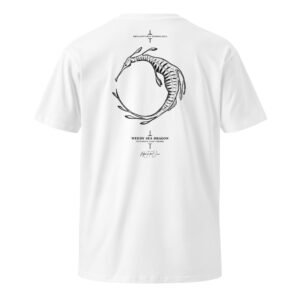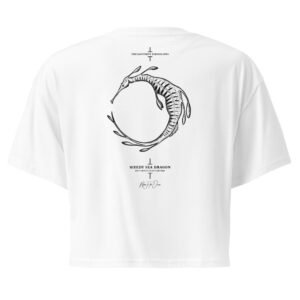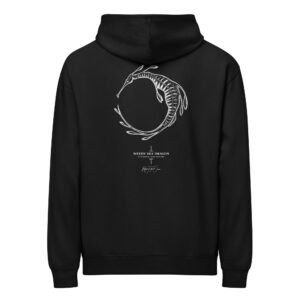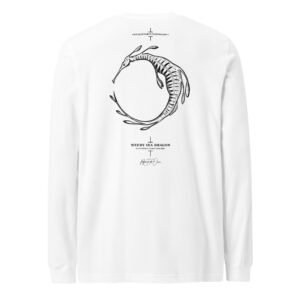
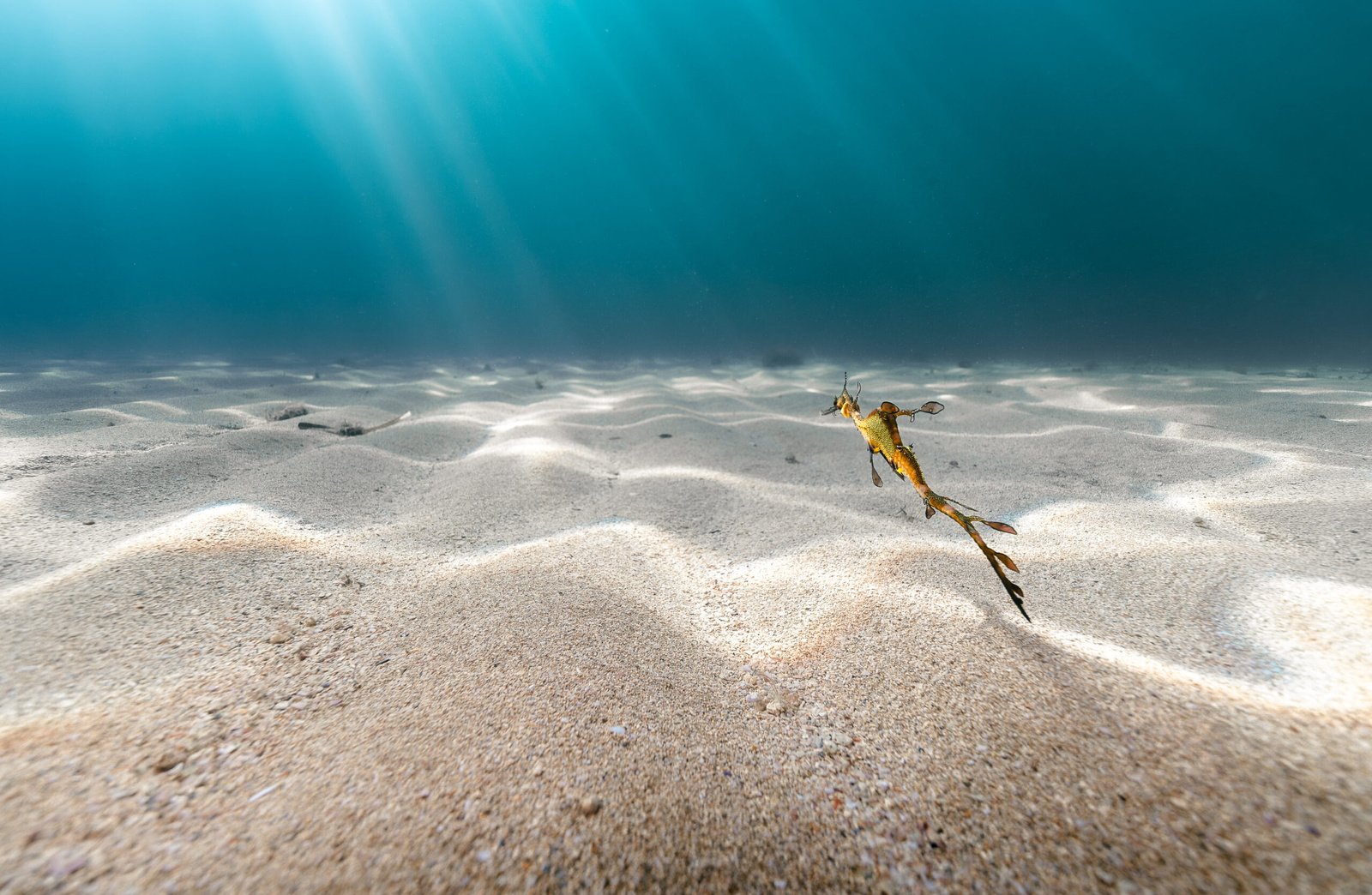
Drifting among the kelp and seagrass of southern Australia is one of the strangest and most beautiful fish in the world. It looks like a piece of seaweed that has come to life, with leafy appendages, a long tube-shaped snout and a body painted in red, yellow and purple. It is the weedy sea dragon, and you will not find it anywhere else on Earth.
The weedy sea dragon is one of our 1st Edition designs. Here is the science behind it, the artist who drew it, and the foundation your purchase helps support.
Meet the weedy sea dragon (Phyllopteryx taeniolatus)
Weedy sea dragons, also known as common seadragons, are found only along the southern coast of Australia, from around Port Stephens in New South Wales, south to Tasmania and west to Geraldton in Western Australia. They live on rocky reefs, kelp forests and seagrass beds, usually in water from just a few metres to around 50 metres deep.
They grow to around 45 centimetres long and are the marine emblem of Victoria.
Cousins of the seahorse
Sea dragons belong to the family Syngnathidae, which includes seahorses and pipefishes. The name means “fused jaw”, referring to the long, tube-like snout these fish share.
Australia is home to three species of sea dragon: the weedy sea dragon, the leafy sea dragon and the ruby sea dragon. The ruby sea dragon was only described by scientists in 2015, from museum specimens collected off Western Australia, and was filmed alive in the wild for the first time in 2016. It shows how much is still waiting to be discovered, even in our own waters.
Unlike seahorses, sea dragons cannot curl their tails around seaweed to hold on. Instead, they drift and hover, steering with small, almost transparent fins on their neck and back that flutter so quickly they are hard to see.
Biology of a living piece of seaweed
- Camouflage. The leaf-like appendages on a weedy sea dragon’s body are not fins and are not used for swimming. They help it blend into the kelp and seaweed, and sea dragons even sway with the swell to complete the disguise.
- A tiny vacuum. Sea dragons have no teeth. They feed by sucking tiny crustaceans, mostly mysid shrimp, into their tube-like snout with a quick snap of suction.
- Dads do the carrying. Like seahorses, it is the male sea dragon that carries the eggs. After an elaborate courtship dance, the female transfers up to around 250 bright pink eggs onto a spongy brood patch under the male’s tail. He carries them for around a month until they hatch.
- On their own from day one. Newly hatched sea dragons are only about two centimetres long and receive no parental care. Very few survive to adulthood.
Why they need healthy reefs
Weedy sea dragons tend to stay in a small home range for much of their lives, which makes them closely tied to the health of their local reef. They are vulnerable to habitat loss, pollution, coastal development and the loss of kelp forests as ocean temperatures rise. Big storms can also wash large numbers of sea dragons ashore, and some local populations have declined.
They are listed as Least Concern on the IUCN Red List, and are protected under Australian law, but their future depends on protecting the reefs they call home.
The artist: Holly Bodaburrows
Our Weedy Sea Dragon design was illustrated in black and white by Holly Bodaburrows, an artist based in Perth, Western Australia. Holly’s detailed linework highlights the elegance and distinctive features of the weedy sea dragon, capturing its character in a minimalist, timeless style.
This collaboration reflects our shared passion for local marine life, and shows how simplicity in art can inspire curiosity and appreciation for the ocean’s wonders.
40% of the profits from this design go directly to Holly.
The cause: the Great Southern Reef Foundation
Every Weedy Sea Dragon purchase supports the Great Southern Reef Foundation. The Great Southern Reef is the network of temperate reefs that stretches across Australia’s southern coastline for more than 8,000 kilometres, from New South Wales to Western Australia. It is home to extraordinary biodiversity, including kelp forests and iconic species like the weedy sea dragon, and a huge number of the species found there live nowhere else on the planet.
Despite its size and importance, the Great Southern Reef is far less well known than the Great Barrier Reef. The Foundation works to change that, through research, community engagement, storytelling and habitat restoration, so these vital reefs, and the animals that depend on them, are protected for the long term.
Shop the Weedy Sea Dragon collection
Wear the weedy sea dragon and help protect Australia’s southern reefs. 40% of profits from this design go directly to the artist, and 30% of Return to the Ocean’s profits are donated to ocean conservation.