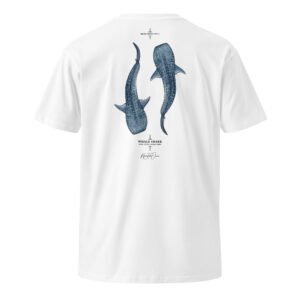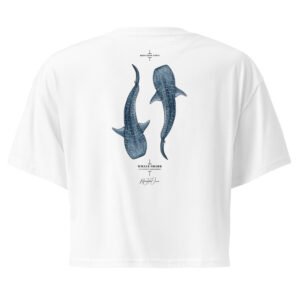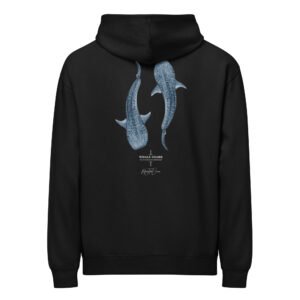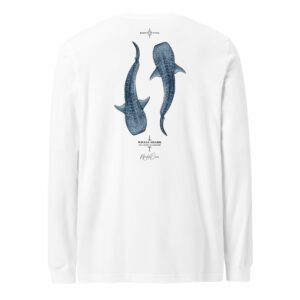
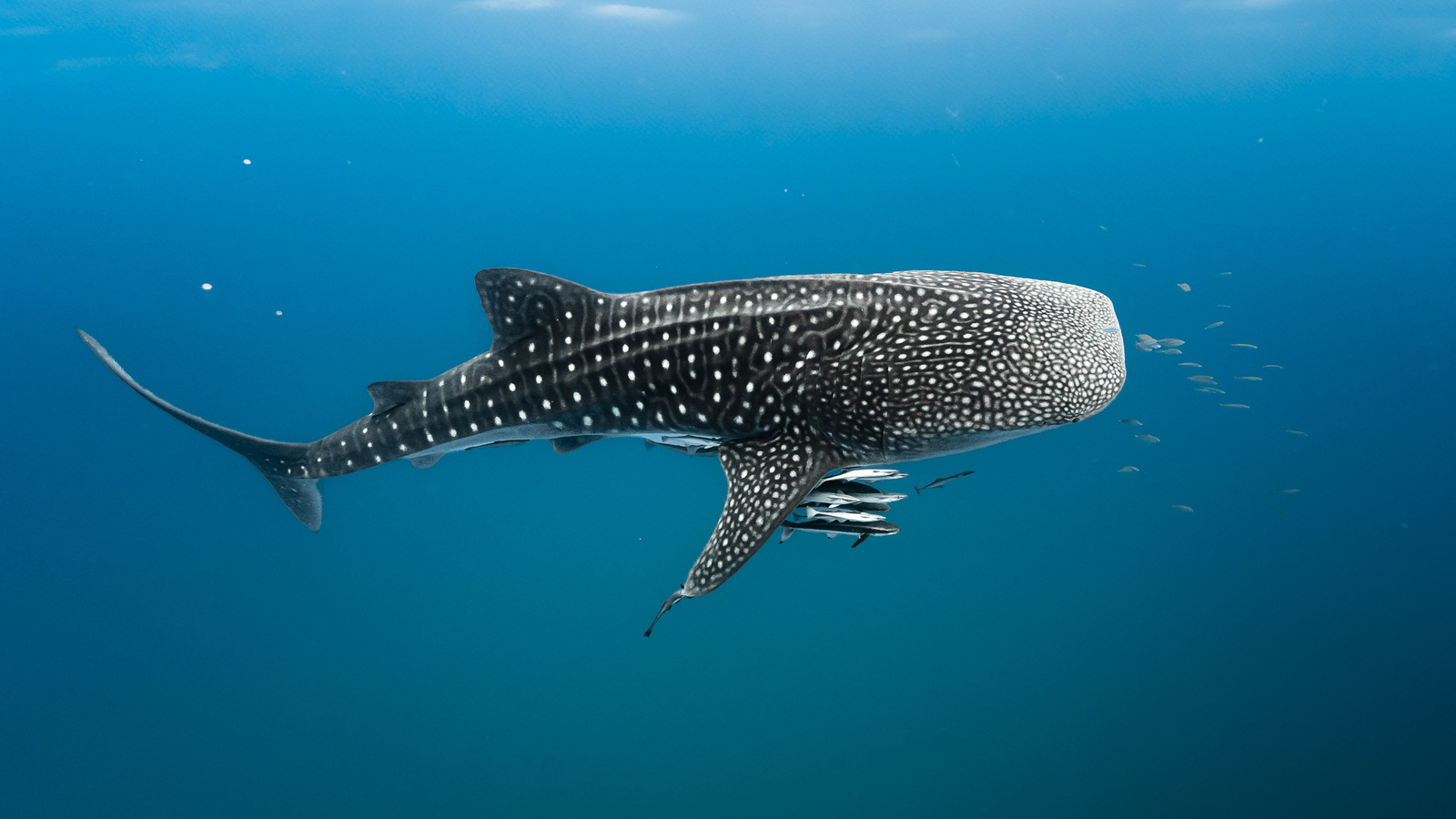
Swimming next to a whale shark is one of the great experiences in the ocean. It is the biggest fish on the planet, longer than a bus, and yet it is completely harmless, cruising along with its mouth open, straining the water for some of the smallest food in the sea. Here in Australia, Ningaloo Reef is one of the best places in the world to see them.
Here is the science behind the whale shark, the artist who drew our design, and the Australian charity your purchase supports.
Meet the whale shark (Rhincodon typus)
Whale sharks are found in tropical and warm temperate oceans around the world. They commonly reach 8 to 12 metres, and the largest reliably measured individuals have been close to 19 metres long. Every whale shark is covered in a pattern of white spots and stripes on a dark blue-grey background, and that pattern is unique to each individual, like a fingerprint.
Despite the name, a whale shark is not a whale. It is a shark, and therefore a fish, that happens to be as big as some whales.
The biggest member of the carpet shark family
Whale sharks are the only living species in their family, the Rhincodontidae. Surprisingly, they belong to the order Orectolobiformes, the carpet sharks, which includes much smaller, mostly bottom-dwelling species like wobbegongs, nurse sharks and leopard sharks.
Somewhere in their evolutionary history, the whale shark’s ancestors left the seafloor and moved into open water, where they evolved to feed on plankton. Filter feeding has evolved separately several times in sharks and rays, in whale sharks, basking sharks, megamouth sharks and manta rays, and each time it has produced some of the largest animals in the ocean. Plankton is abundant, and eating low on the food chain can support a huge body.
Biology of a gentle giant
- Filter pads instead of teeth. Whale sharks have thousands of tiny teeth, but they do not use them to eat. Instead, they filter plankton, krill, fish eggs and small fish through spongy filter pads in their gills. They can swim with their mouths open, or hang still in the water and gulp, sucking in water and food.
- Armoured eyes. Scientists discovered that whale sharks have tiny tooth-like scales, called dermal denticles, covering their eyeballs, which likely protect their eyes from damage. They can also pull their eyes back into their sockets.
- Mysterious reproduction. Whale sharks give birth to live young. In 1995, a pregnant female caught off Taiwan was found carrying around 300 pups at different stages of development, suggesting females may store sperm and give birth over time. Almost nothing is known about where whale sharks mate or give birth.
- Long lives. Whale sharks are thought to live for many decades. Researchers used radiocarbon from Cold War nuclear testing, absorbed into the vertebrae of sharks alive at the time, to confirm that growth bands form once a year, showing that one individual was around 50 years old.
- Big travellers. Satellite tags have tracked whale sharks travelling thousands of kilometres, and some regularly cross entire ocean basins.
Ningaloo and the coral spawning
Every year from around March to July, whale sharks gather at Ningaloo Reef in Western Australia. Their arrival is linked to the mass coral spawning that happens in autumn, which fuels a boom in plankton and the small animals that feed on it.
Ningaloo became one of the first places in the world where whale shark tourism was carefully managed, and it showed that whale sharks are worth far more alive than dead, to local communities and to the economy.
Why they need protecting
Whale sharks are listed as Endangered on the IUCN Red List. Global populations have declined by more than half over the last 75 years. Threats include targeted fishing in some parts of the world, bycatch, and ship strikes, which are a growing concern because whale sharks spend a lot of time feeding near the surface along busy shipping routes. Their slow growth and late maturity mean populations take a long time to recover.
The artist: Rachel Brooks
Our Whale Shark design was created by Rachel Brooks, an artist based in the Scottish Highlands. Rachel built this whale shark through pointillism and ink, using thousands of tiny, deliberate marks, the same painstaking technique she has used to become one of the most recognised names in scientific marine illustration.
Rachel is not drawing from imagination alone. With a background in zoology and eight years working as a scuba instructor across the Indo-Pacific, she has dived alongside whale sharks herself, and brings that firsthand experience into every piece. She calls her practice “artivism”, art as activism, using intricate, scientifically accurate illustration to reconnect people with species most will only ever see in a picture.
40% of the profits from this design go directly to Rachel.
The cause: ECOCEAN
Every Whale Shark purchase supports ECOCEAN, an Australian marine conservation charity founded by marine biologist Dr Brad Norman.
ECOCEAN built and runs the Whale Shark Photo-Identification Library, a citizen science database that matches individual whale sharks by their unique spot patterns. It uses a star-mapping algorithm originally developed by astronomers to identify patterns of stars in Hubble Space Telescope images. The same maths that maps galaxies can tell one whale shark from another.
The library has grown into the largest whale shark database in the world, with tens of thousands of photos and sightings submitted by divers, tourists and researchers. It drives real insight into how this endangered species moves, lives and where it needs protecting most. Anyone who swims with a whale shark and takes a photo of its side can contribute.
Shop the Whale Shark collection
Wear the whale shark and help protect it. 40% of profits from this design go directly to the artist, and 30% of Return to the Ocean’s profits are donated to ocean conservation.